Resin vs block paving vs tarmac: which driveway is best?
There is no single best driveway. Tarmac is the most economical hard surface at £35–£60 per m² on our guide and suits long or large drives. Block paving (£40–£80) gives the most choice of pattern and is easiest to repair. Resin bound (£60–£95) costs most but is smooth, seamless and permeable.
All three last well when the base underneath is built properly. The choice comes down to budget, looks, drainage and how you use the drive.
How do resin, block paving and tarmac compare?
| Feature | Resin bound | Block paving | Tarmac |
|---|---|---|---|
| Guide price per m² | £60 – £95 | £40 – £80 | £35 – £60 |
| Two-car drive, 30 m² (surface only) | £1,800 – £2,850 | £1,200 – £2,400 | £1,050 – £1,800 |
| Typical time on site, 30 m² | 1–2 days | 1–2 days | 1–2 days |
| Look | Smooth, even natural stone | Patterned, many colours | Clean and uniform |
| Drainage | Permeable on a permeable base | Permeable versions available | Standard tarmac needs drainage |
| Repairs | Patch repairs can show | Lift and relay single blocks | Patched; the patch usually shows |
| Ready to use | After curing: usually drive on it after a day or two | Normally straight away | Ask at the site visit |
Prices are guide prices from our price calculator, including labour, materials and VAT where applicable; times are the calculator's guide once groundwork is done. Removing an old surface adds £8–£15 per m².
How much does a tarmac driveway cost?
On our guide, tarmac is £35–£60 per m². That is about £550–£900 for a 15 m² single-car drive, £1,050–£1,800 for a 30 m² two-car drive and £1,600–£2,700 for 45 m², before extras such as removing the old surface, drainage and edging. Its low cost per m² and quick laying make it a natural choice for long drives and large parking areas.
When is tarmac the best choice?
- You have a large or long area and want the lowest cost per m² for a hard, sealed surface.
- You want a clean, plain finish rather than a pattern.
- You are happy to plan drainage: standard tarmac does not let water through, so a front drive over 5 m² needs to drain to a lawn, border or soakaway, or it needs planning permission. Porous asphalt is a permeable alternative.
The downside is repairs. If the drive is dug up or damaged, it is patched, and the patch usually shows.
When is block paving the best choice?
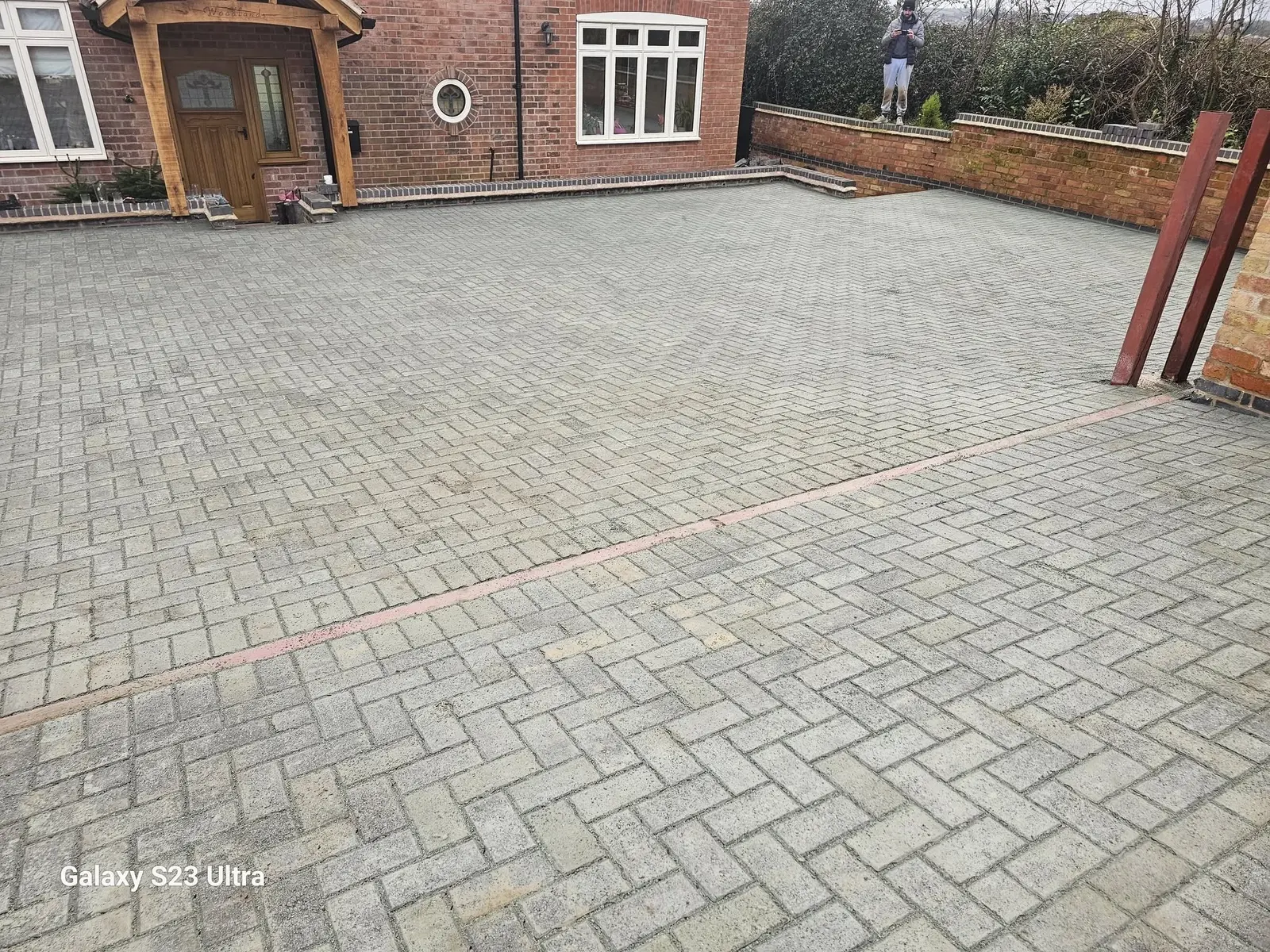
- You want pattern and colour: herringbone, stretcher bond, borders, bands and curves.
- You want a drive that is simple to repair. Blocks can be lifted and relaid if a utility company needs to dig, or replaced one at a time.
- You want to use it straight away: once compacted and sanded, block paving can normally be driven on the same day.
Every block paving drive we lay goes on a dug-out, compacted MOT Type 1 sub-base. The joints need a top-up of kiln-dried sand every few years, and weeds need pulling while they are small.
When is resin bound the best choice?
- You want a smooth, seamless, modern finish with no loose stones, kind to feet, buggies, wheelchairs and bikes.
- You want a permeable drive without gravel: resin bound on a permeable base lets water soak through, so it normally avoids the need for planning permission.
- You want to match the house: the colour is the colour of the natural stone, from golds and buffs to greys and charcoals.
Resin costs more and depends heavily on the base and the weather on the day it is laid. It cannot be laid in rain or near freezing, and it needs UV-stable resin so the colour does not yellow.
What about gravel?
Gravel is the cheapest option on our guide at £20–£40 per m², and it is fully permeable. The trade-off is loose stones: it moves under tyres, needs raking and is harder going for buggies and wheelchairs.
What should I ask an installer before choosing?
- What sub-base will you lay, how deep, and in what material?
- Where will the rainwater go, and does that mean the drive needs planning permission?
- Will the old drive be dug out or overlaid, and are removal and waste included in the price?
- What edging will hold the surface in place?
- Is the price fixed and in writing, and what guarantee comes with it?
Comparing quotes on these points tells you far more than comparing the price per m² alone.
Which driveway lasts longest?
How long a driveway lasts depends more on what is underneath than on the surface. Dips, ruts, cracks and puddles nearly always start with a base that was too thin, badly compacted or poorly drained. Whatever you choose, ask each installer what sub-base they will lay, how deep, how the water will drain, and what guarantee they give in writing. Every drive we lay carries our 10-year guarantee.
Resin vs block paving vs tarmac: which should I choose?
- Tight budget or large area: tarmac, or gravel if loose stone suits you.
- Traditional look, easy repairs: block paving, in herringbone for a drive.
- Modern, smooth and permeable: resin bound.
Many drives mix them: a resin or tarmac field with a block paving border, for example. We bring samples to the site visit so you can see them in your own light.
Quick answers
- Cheapest hard surface: tarmac, £35–£60 per m² on our guide.
- Easiest to repair: block paving.
- Best for drainage: resin bound on a permeable base, gravel or permeable block paving.
- Tarmac driveway cost, 30 m²: about £1,050–£1,800 for the surface.
- What matters most: the sub-base and drainage, whichever surface you pick.
Compare surfaces on our driveways page, see block paving and resin driveways in detail, try the price calculator, or book a free site visit for one fixed, written price.
Last updated: 29 September 2026. Written by Lucian, owner of C&L Landscaping & Driveways, Sutton-in-Ashfield.